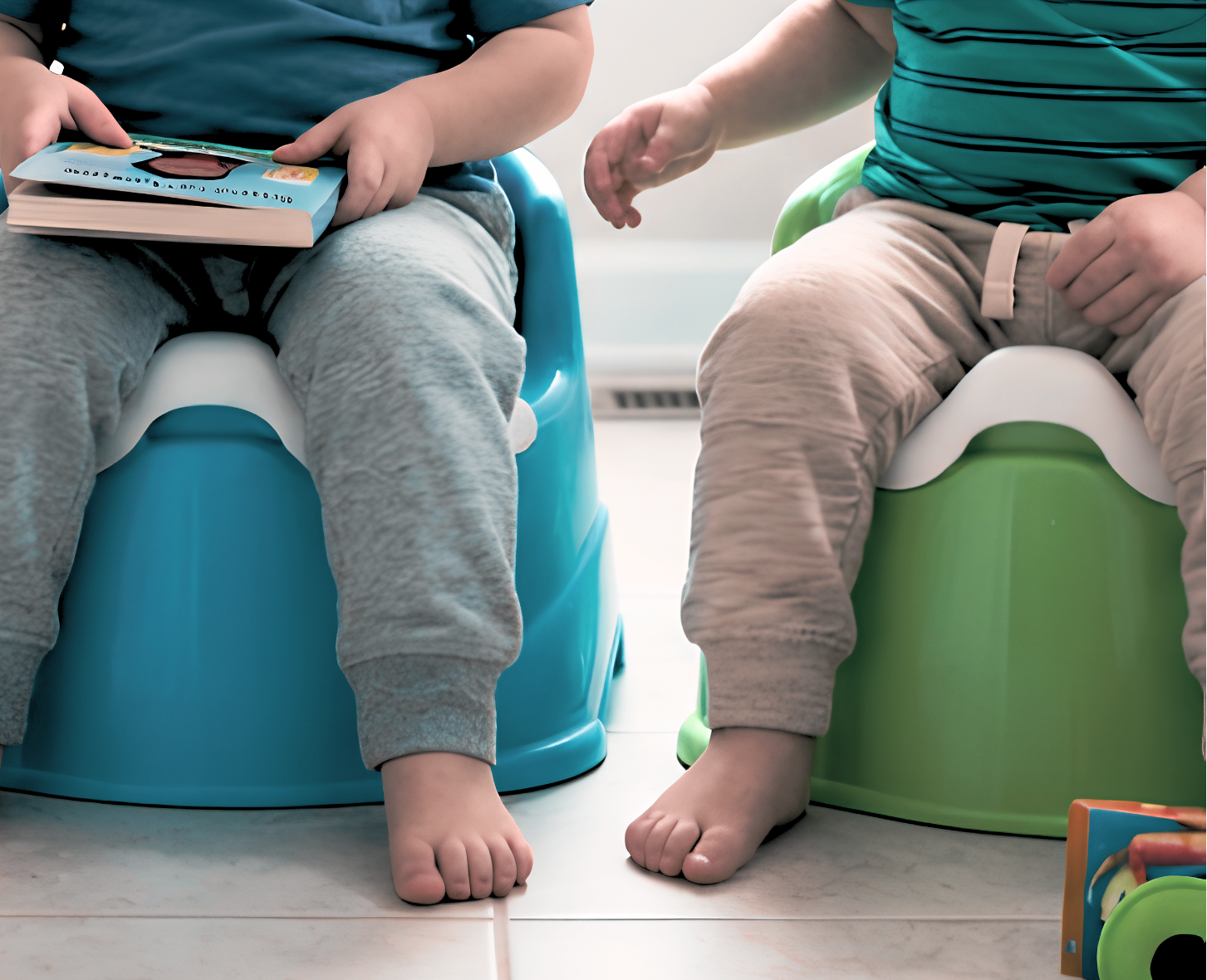
Supporting twins to use the toilet can quickly feel overwhelming before you even begin. You may be asking yourself, how do I know when my twins are ready for toilet learning? What if only one twin is interested in potty training? How do you toilet train toddlers on the go?
Toilet learning for twins, commonly called potty training twins, comes with its own unique challenges.
There are hundreds of programs and methods, including the naked method, the 3-day challenge, reward-based potty training and more. As a twin parent, you probably have questions about how advice designed for singletons translates to two children at once. Which potty training method works best for twins? Should twins be potty trained at the same time or separately?
This guide offers perspective from a twin mom, a mom of three under two years old, on what toilet learning for twins can look like through a Montessori lens.
When Are Twins Ready for Potty Training?
In the beginning, our twins showed pockets of readiness before their second birthday. With a newborn in the mix, it completely caught us off guard.
According to pediatric experts, the average age for starting potty training is typically between 24 and 30 months (2 to 2.5 years old), with most children fully trained by age 3 to 4. However, many toddlers begin showing readiness signs earlier, around 18 to 24 months. Girls often start and master the process slightly sooner than boys.
Potty-training or Toilet learning Twins?
In Montessori, the phrase toilet learning and sometimes elimination learning is used in place of the commonly used potty training. Not to put on airs, but to signal to the child (and ourselves) that this will be a gradual, respectful learning experience just the same as we approach other learned skills like eating, dressing or shelf work.
Potty training brings to mind the idea of being adult directed and child conforming. Toilet learning invites the child to explore and experiment within acquiring a new self care skill in their own time. We are their guides. We provide support, clarity and, when needed, boundaries.
Preparation for the Parent
Toilet learning is also a huge change for the adult, and one that will bring on a range of emotions. Like the child, we have gotten used to depending on diaper changes and probably settled into a comfortable rhythm. At this age, diaper changes also became less frequent and more predictable. Now, you are being challenged to step outside that sliver of stability into another compounded challenge.
Supportive Language and Modeling
Toilet learning should always be presented as a positive learning experience. Shame and fear will only bring out hesitation and regression. For your child, eliminating (urinating and bowel movements) in their diapers is all they have ever known. A safe place that was rewarded with tender care and face to face attention once they needed their diaper changed. Now, your little one is being asked to take on new responsibilities.
We must not take for granted what an enormous under taking this is for our little ones!
This can be a powder cake opportunity for tears and power struggles. However, going into a situation with a clear sense of what is to be expected, and modelling that expectation respectfully, helps set the tone for mutual cooperation. Our children look to us for guidance, a sense of security in the new. I found when I am clear and confident in my words, my children are more self-assured too.
Positive Phrasing
In Montessori the word miss is used in place of accident. A miss honours the attempt and effort put into the work of toileting, rather than assigning blame with a word like “accident”.
Structure response like:
” I see you really tried to make it to the toilet”
Instead of saying:
“that’s ok, accidents happen”
Here, we are praising effort over outcome, while still providing direction on what the ideal outcome would be. We still need children to connect pee/poo belongs in the toilet. Toilet learning can be deeply emotional, and you can feel compelled to offer comfort (even if the child does not feel bothered) by telling the child “its ok” “don’t worry” or accidents are expected. This can give the children the wrong idea, and set you up for power struggles down the road.
In another example, we can equip our child with what to do should a miss occur, rather than assigning blame or belittling.
Structure response like:
“Your body is still learning to stay dry at night. Lets change the bedding together”
Instead of saying:
“You made a big mess” or “Big boys/girls don’t pee the bed”
Staying dry overnight or during nap will take longer for most children. Strategies like reducing water leading up to sleep, and toileting before bed. Otherwise, we focused on letting our children know the sequence of steps for cleaning themselves, changing clothes, and disposing of soiled clothes in the laundry. Keep reading to learn how we manage misses.
Anatomically Correct Language
Anatomically correct language is important for children to learn from the start. There is no reason to substitute “child friendly” slang for their body parts, or for the process of using the washroom. This will only foster confusion and a sense of immaturity towards correct language later in life.
Our little ones use and understand correct terms such as penis, vulva, bladder, and bottom. At the same time, simple words like pee and poo for elimination are perfectly appropriate and widely understood. They understand the words bowel movement and urinate, but have staked their preference.
We use anatomically correct language while demonstrating wiping is only done from front to back. From penis to bottom or from vulva to bottom, as applicable.
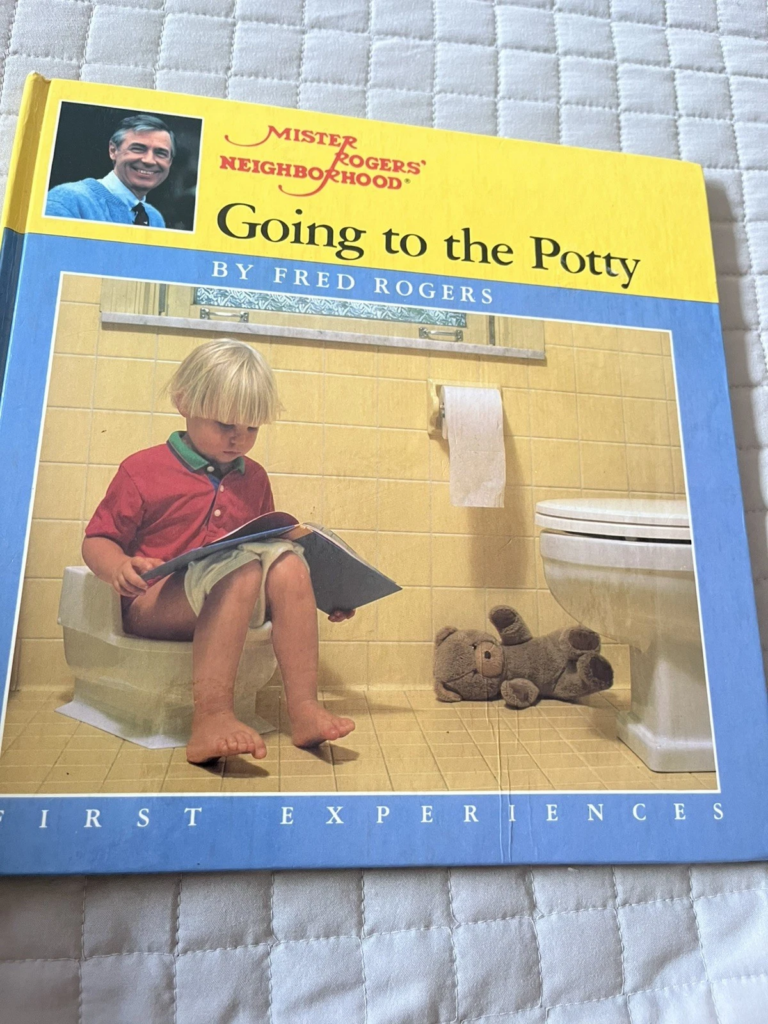
The book Going to the Potty by Fred Rogers (Mr. Rogers) does an excellent job of naming and explaining the elimination process. We highly recommend for toilet learning twins.
Invite Natural Toilet Times Throughout the Day
It is important that children begin to recognize the internal sensation of needing to use the toilet on their own without prompting from parents. However, there are moments throughout the day when we queue our twins to toilet.
In the morning when they wake, before leaving the house, upon arriving somewhere, before nap, after nap and before bedtime.
I reasoned these queuing times naturally align with when most adults would choose to toilet anyways. This lays the groundwork for healthy habits our twins will naturally integrate into the rhythm of their day. I want to go outside and play, I should toilet now so I don’t have to come back in side. At 3 years old, this strategy is fully integrated part of their natural rhythm. No power struggles.
Follow Each Twin as an Individual in Toilet Learning
When toilet learning twins, it’s essential to recognize each child as an individual. While twins often develop side by side, their readiness, comfort levels, and pace can differ. Boy/girl twins will come with even more challenges.
Even if they appear to be in sync, avoid assuming their progress will always match. Respecting each child’s unique timeline helps build confidence and reduces unnecessary pressure.
Toilet Learning Happens At Their Pace
Many parents approach toilet learning (potty training) as a crunch time sprint, and endevour to get the experience over as quickly as possible. In Montessori, we appreciate that children must take their time to explore the new space, new equipment, and new routine before they are able to string it all together.
They may sit on the toilet just to see how it feels. They may have great interest in the water, the act of flushing and the accompanying sounds. Others may be startled and unsure. Your twins may have polar opposite impressions.
Our twins were pretty much in step with one another for day time toilet learning. Each were showing signs of readiness at the same time, and were eager to participate in what the other was doing. Peer influence, or put another way mimicking their twin, can be a great tool for learning. But as twin parents know, it can be a double edge sword. Monkey see monkey do can also apply to less desirable acts of curiosity.
Avoiding Comparison Between Twins
The important thing is not to compare, or try to influence one twin to keep up with the other.
Instead of saying:
“Why can’t you use the toilet like your brother/sister”
Use neutral, broadcasting language that makes both children feeling respected
“Toddler B just went pee in the toilet” with an optional “Lets go use the toilet too”.
Try not to tack on a “ok?” or anything that turns the prompt to use the toilet into a question to avoid a power struggle.
Just as our choice of words is important, so is the delivery. Check yourself for sarcasm, frustration or an angery tone. One twin may act in a way that is more desired than the other, but we must do our best not to leave the other twin feeling lesser.
In this very sensitive time our children are counting on us to be extra supportive and understanding.That said, I think it is very important that we don’t present ourselves as flawless, perfect people. Child should learn that adults have a range of emotions too, and a healthy way of managing them.
Toileting: One Toilet Seat or Two? Big or Small?
When we first prepared the space, we introduced two small, mini toilets. We wanted to observe whether our twins preferred a child-sized mini toilet, or adapting the existing standard toilet. We also liked the idea of having a backup available in case the main one was in use.
They showed us very quickly what they preferred…
ToyLet Toilet Training Potty
We purchased these off marketplace. I know for some, the ick factor makes second hand a hard no. For us, we simply weren’t interested in paying full price. Hard plastic is easy to sanitize. Most items, we turn around and resell for the same price. This is one of the top reasons I will never do affiliate links on the blog. I think the second hand market is where it is at for value, environmental impact, and ethical recommendations.
We started off with purchasing two, from another twin mom coincidentally!
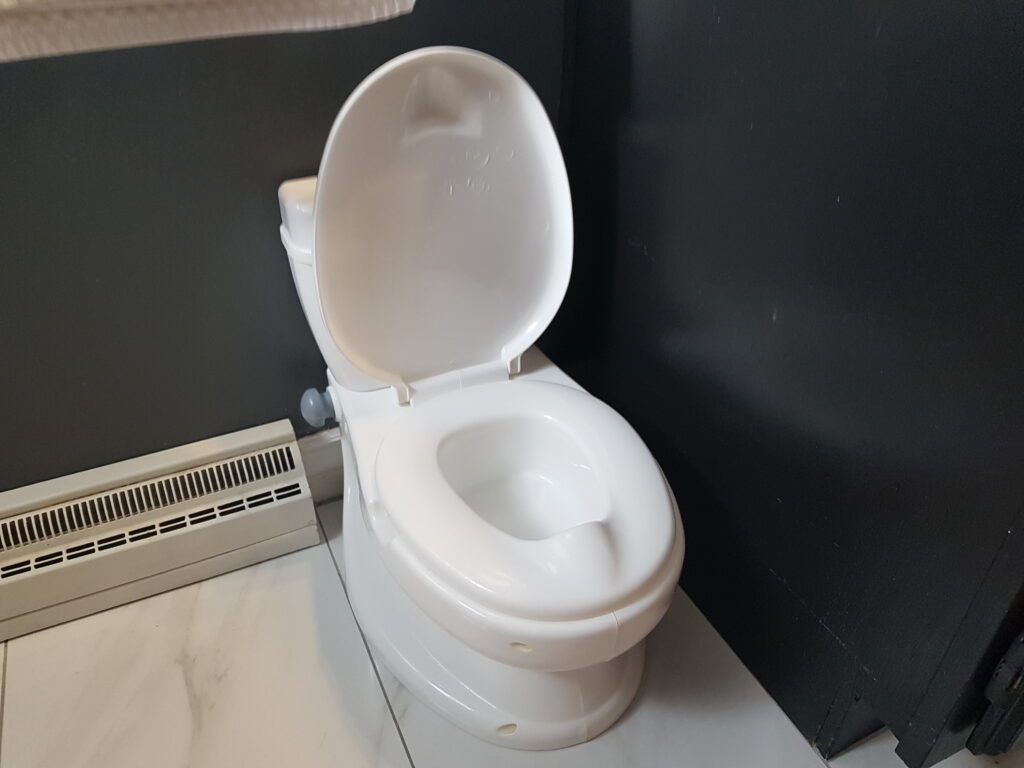
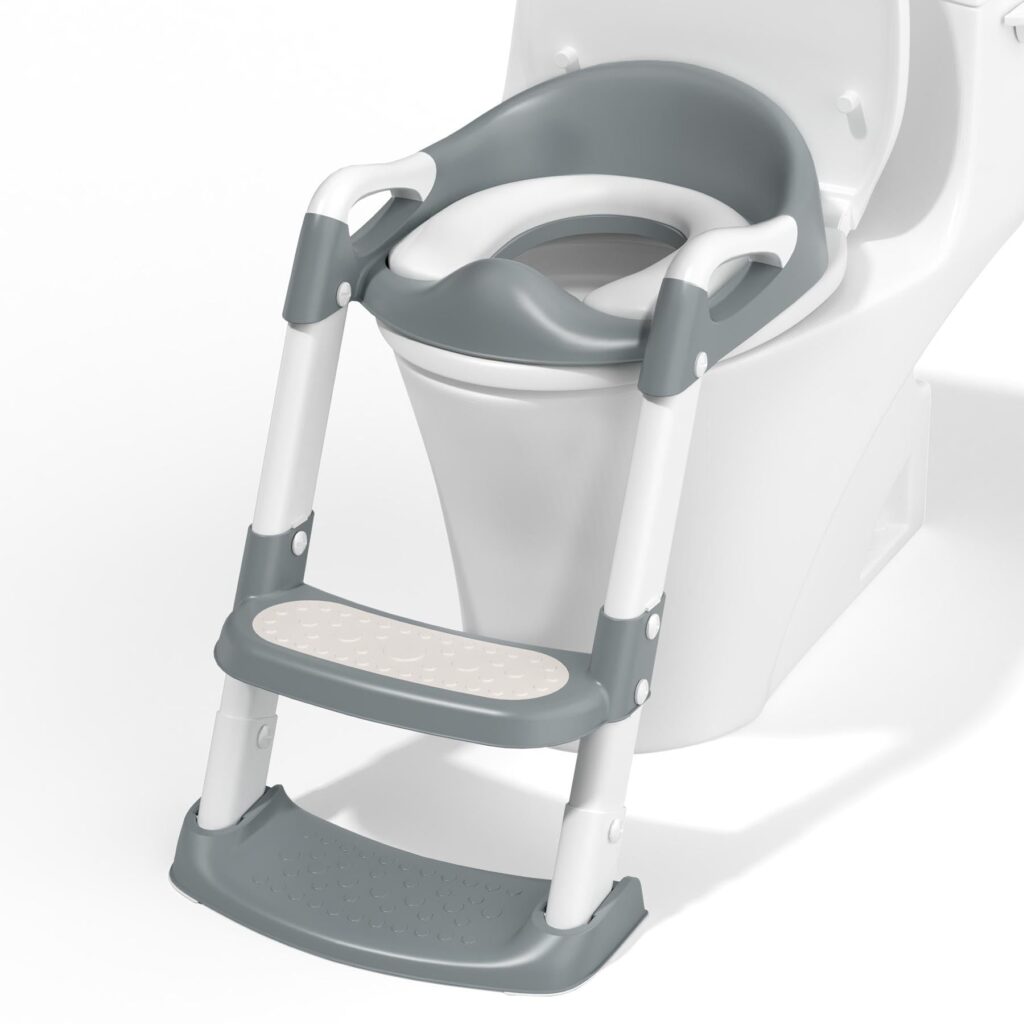
COOSEYA Potty Training Toddler Toilet Seat
In addition to a child-size potty chair, we got a seat that goes onto the big toilet. I liked having two choices for the twins to choose from. The seat has multi-steps they could safely climb up and position themselves independently. We ensured the set up was stable enough for turning, pulling up pants, and stepping down confidently. I think they enjoyed the big movement effort involved. Our twins were so proud to use the same toilet that we use.
Once the grew a little taller, we replaced this with just a step stool.
The Unanimous Twin Verdict:
Although the mini toilets were accessible and novel, they consistently chose to use the real toilet, preferring to be like us. The smaller toilet became something of a play object. They were curious about it, moved it around, and interacted with it as they would any new material. That told us something important. To them, it felt like a toy. It was separate from what the rest of the household used.
In Montessori philosophy, children are deeply motivated to participate in authentic, meaningful activities. They want to do what the adults do. Using the real toilet was, to them, a mark of their capability. So we adapted the environment by removing the smaller mini toilets. This experience was a good reminder that, whenever possible, offer real tools for real work. It’s also a comforting buffer against social media pushing extravagant child-only stations that most homes can’t accommodate (or afford!).
Going On The Go
The most significant challenge you will find in your toileting journey with twins will be how to go on the go. Sure, diaper changes can be inconvenient (and costly) but virtually any place you and the twins went had someway to change a diaper. Even if you had to get creative and unapologetic about it. Now, every place we went, we had to ask “does it have a bathroom?”.
In our corner of the world, city parks, beaches, and outdoor spaces only had seasonally available bathrooms. We, as it turns out, started our toilet learning journey in the dead of winter.
Portable seat reducer- One Proud Toddler
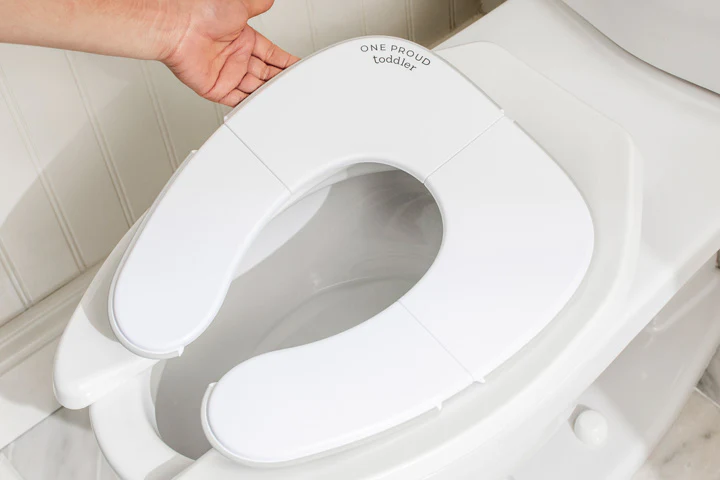
This was a really fantastic option for visiting friends, family, extended shopping trips and even port-a-potties on outdoor adventures. I was usually solo parenting my twins, with a newborn singleton in tow. I needed something light, slim and easy to clean that could be stored in our baby bag. This did the job perfectly. It can also be very handy for those with two home bathrooms, allowing you to quickly convert the lesser used washroom when emergency strikes. With twins, and 3 under 2 years, it just might.
Creating a Child-Friendly Montessori Bathroom at Home
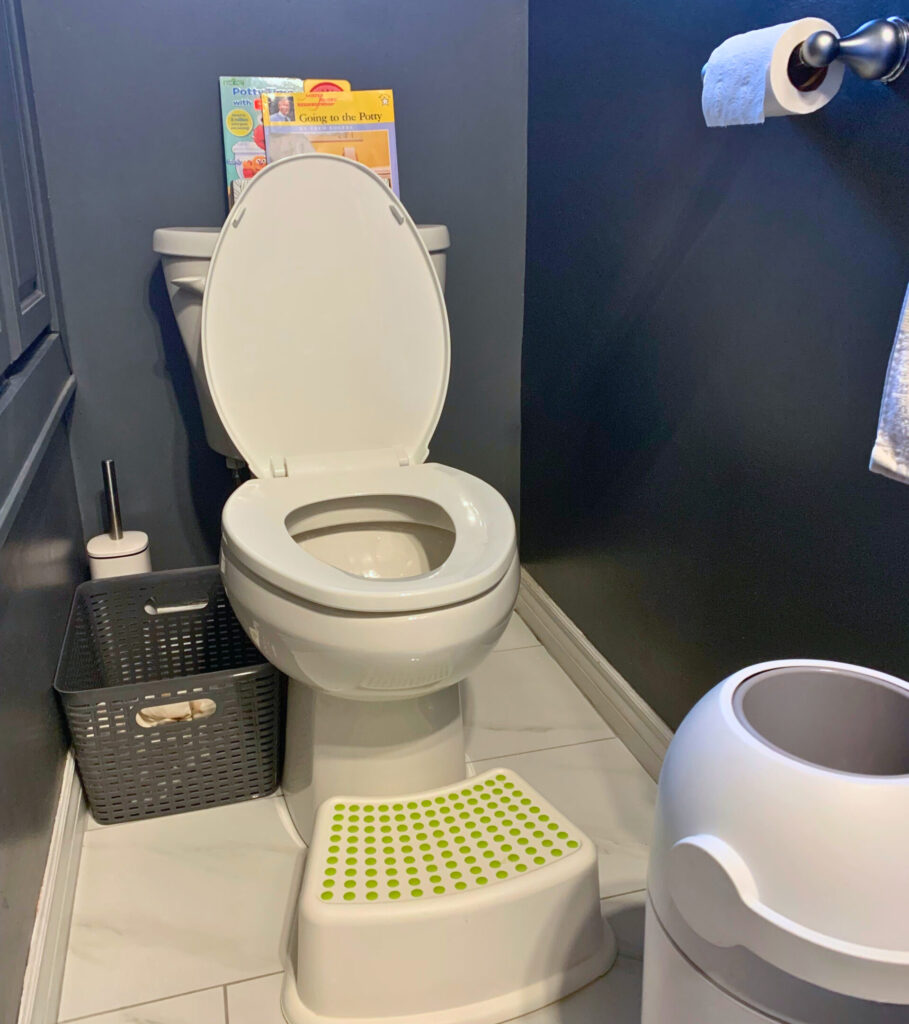
The Montessori bathroom is an important part of our Montessori home. Our twins had a natural independence streak (and their sister has followed suit), so will capitalized on their interest for independence by creating a bathroom they could use by themselves.
At around 18 months old, my twins increasingly expressed a desire to independently use the washroom for self care and toiling. Preparing the environment to support this need was at first a change. We had to take into account something each twin’s individual preferences, the cramped space, and the rhythm of our family. Once mastered, our daily routines became so much smoother, and our children so very proud to be taking charge of their own care.
You can read my in depth blog post on how simple adjustments can make a big difference for A Montessori Bathroom At Home.
Managing Accidents Misses
In Montessori the word miss is used in place of accident. A miss honours the attempt and effort put into the work of toileting, rather than assigning blame with a word like accident.
A Waste Bin For Managing Pull-Ups
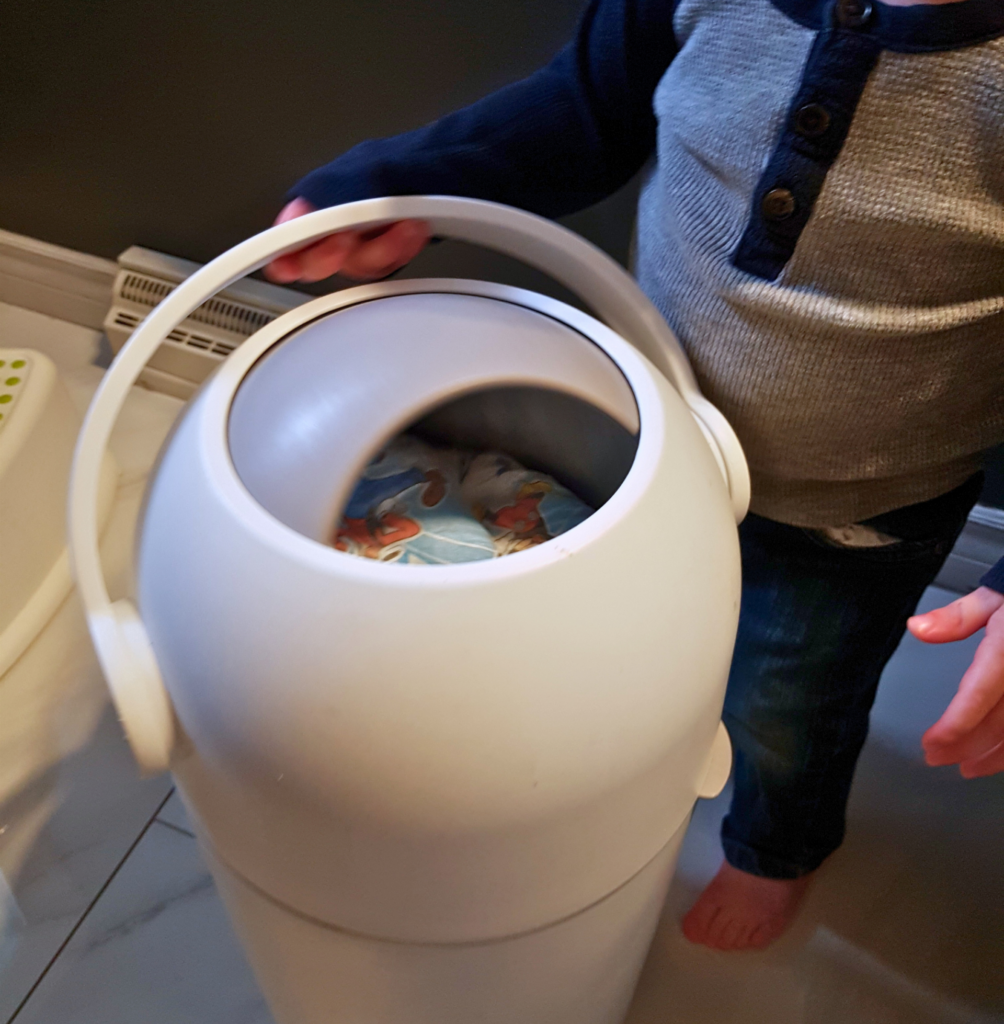
Toileting doesn’t happen over night. Many children continue to use pull ups for naps, and then still over night for months or years after they are fully toilet trained during wake hours. Have a waste bin for them to independently dispose of their diapers, or a laundry bin if using reusables. Teaching a child to manage this step themselves builds responsibility beyond recognizing the need to go.
Diaper genies are great for managing the smell, but I didn’t like that they required pricier refill rings. Instead, we used the Magic Majestic diaper pail. Great odor control, no propriety bags and our little ones were easily able to use it unassisted to dispose of their pull ups themselves. Possibly a good option for storing soiled reusable diapers too.
A Laundry Basket To Support Toilet Learning
Next to the toilet, there’s a small basket for laundry to go into as needed after toileting or before the bath. Toilet learning twins is a slow, gradual process. It’s important to keep the process positive. Having this system in place removes the shame from misses. Instead of being embarrassed or frightened, the child is reassured as they learn. They knows exactly what to do should they not make it to the toilet in time, or if their clothes have become soiled from the day. They can take charge of their situation by knowing there is a safe place were soiled clothing is stored, and where to retrieve clean clothing after. Plastic is best for easy cleaning.
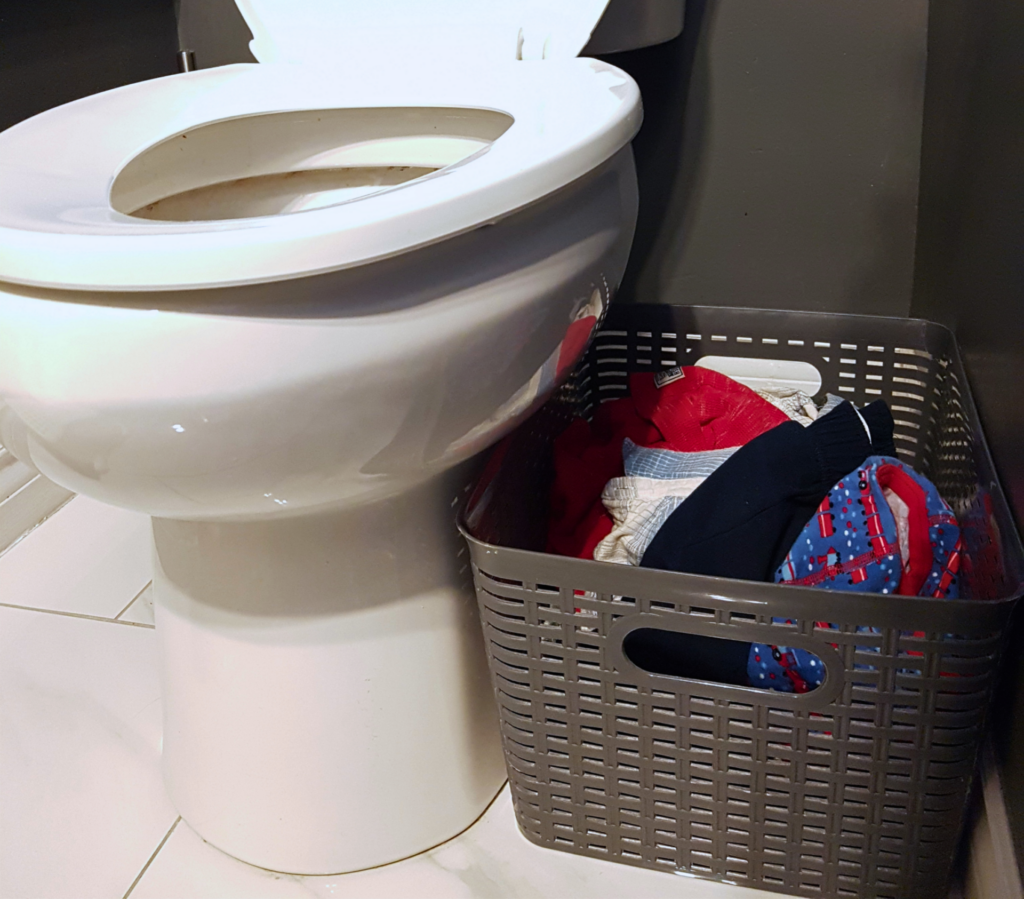
Some families opt for a clean selection of clothing/underwear to be available in the washroom. We found the space too limited, and it’s easy to mix up clean and dirty clothing. Our children simply retrieve new clothes from their capsule wardrobe.
Dress for Toileting Success
Supporting toileting independence, at its core, is about preparing the environment so that the child is fully able to participate without unnecessary barriers. Clothing, it turns out, can be a significant barrier. The catalyst for our twins’ capsule wardrobe, was their toileting journey beginning sooner than we had anticipated. Much their wardrobe was unsuitable.
When selecting clothes your toddlers, keep it simple. Elastic waistbands, soft pull-on pants, and shoes without complicated fastenings allow children to dress and undress quickly. Prioritize comfort over fashion. Clothing that is too tight or difficult to remove creates unnecessary stress during an already new and challenging milestone.
Some toddlers feel most comfortable removing their bottoms completely rather than leaving clothing around their ankles. Skinny jeans or tightly tapered bottoms at the ankles can feel restrictive and distressing when a child is trying to undress quickly. Toddlers can instead focus on recognizing their body’s signals instead of asking for help. This small change had a big impact on our twins’ confidence and ability to use the toilet independently.
Twin FOMO In The Bathroom
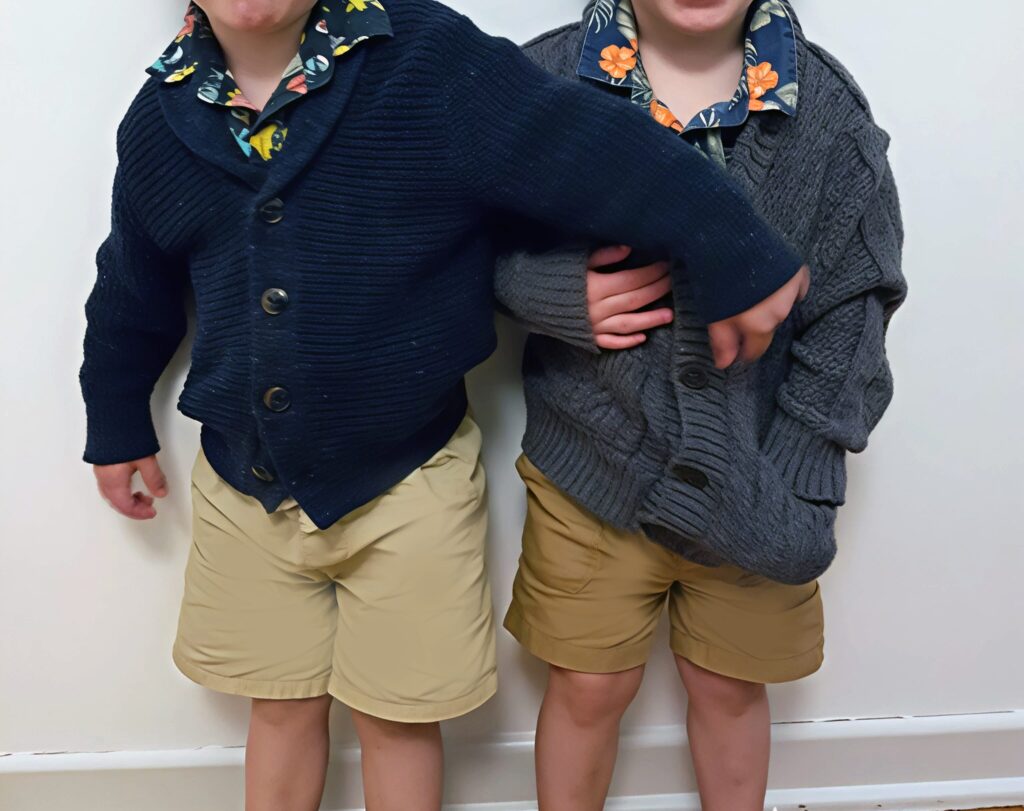
With twins, it can be tempting to have both children completing their bathroom routine at the same time for the sake of efficiency. Twins may even initially advocate for this with a fear of missing out (FOMO). In our home, joint us of the bathroom often led to distraction and frustration. Especially with toilet learning twins.
Instead, we have tried to model the importance of privacy, and independent usage of the bathroom as the norm. In the very early months, this also created some lovely one-on-one moments with each child. One child for example would brush, while the other waited nearby with a quiet activity. As my twins grew older and the routine became internalized, bathroom tasks became more manageable and less novel.
Putting It All Together
Toilet learning with twins is a milestone made all the more intense by the factor of two. Two little ones looking to you for guidance in their transition from diapers to independent care.
As with most things in a Montessori-inspired home, observation is key. What works beautifully for one child may distract another. Even amongst twins, we need to be prepared to adjusting based on the individual needs of the child.
Embracing a Montessori bathroom is one of the most meaningful adjusts we have made in our home for our children. Sometimes Montessori can be misrepresented as activities or products that simulate practical life skills, rather than functional changes in your home that truly support a child’s independence. For our children, the standard real life option, slightly modified, was always the preferred choice. By thoughtfully preparing the space, children are entrusted with their own self care and a deep rooted sense of autonomy.